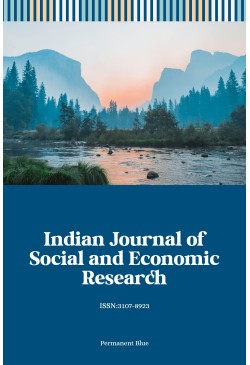
Indian Journal of Social and Economic Research
Frequency :Bi-Annual
ISSN :3107-8923
Peer Reviewed Journal
Frequency :Bi-Annual
ISSN :3107-8923
Peer Reviewed Journal
INDIAN JOURNAL OF SOCIAL AND ECONOMIC RESEARCH: invites submissions for its upcoming issues. IJSER is a peer-reviewed, open-access journal publishing original research articles, reviews, and case studies on all area social and economic research and related fields on social science with a focus on India.
INSTRUCTIONS FOR AUTHORS
Papers must be in English only.
All papers submitted to the journal will be reviewed through a double-blind peer-reviewed process (1–3 reviewers).
All papers should be typewritten in Word (Times New Roman) and emailed to Editor-in-Chief:- Dr. Rachana Bansal, Assistant Professor, Department of Agricultural Economics, B. A. College of Agriculture, Anand Agricultural University, Anand-388110 (Gujarat). India E-mail: rachi.bansal22@gmail.com
The maximum length of the article in double space with 12 pt font size is 30 pages including graphs, tables, and others.
The title page should include the article’s title and the author’s name and affiliation. Address details should include telephone number and email.
The second page should contain the title of the paper, abstract, Keywords, and JEL classification codes. The abstract should not exceed 150 words (100 – 150 words). JEL classification codes are up to three, and Keywords are up to five.
The text of the article should include section headings (designated by Roman numerals – I, II. III,…), and subsection headings (Arabic numbers – 1, 2, 3,…). References should be given in the following form:
Do not use any footnotes, rather put all notes immediately following the article. Numbering should be done using the standard Arabic number system (1, 2, 3, etc.)
References should follow the Notes section at the end of the article.
Tables and graphs should follow the References section. Tables should be numbered consecutively and given a suitable caption and each table typed on a separate sheet.
PLAGIARISM POLICY: Every paper should accompany a similarity index report in Turnitinanti plagiarism software. The plagiarism percentage should not exceed 10-20% per cent.