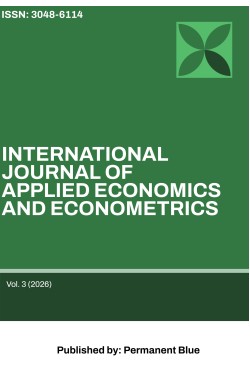
IJAEEInternational Journal of Applied Economics and Econometrics
Peer Reviewed Journal
Peer Reviewed Journal
Study on Alternative Indices (Other than NEER/REER) for Assessing Fair Value of INR
The study examines various alternative indices other than real effective exchange rate (REER) and empirically estimates Behavioural Equilibrium Exchange Rate (BEER) for India. The results indicate that the existing REER is in line with the BEER, barring crises related episodes such as pre-global financial crisis of 2008-09, taper tantrum, US-China trade tensions and the Covid pandemic. Further, it is observed that higher productivity, favourable terms of trade, net foreign assets and higher interest rate differential cause the equilibrium real exchange rate to appreciate while, increase in gross fiscal deficit depreciates it.
Dipak R. Chaudhari, Twinkal Jain & Vejaya Agrawaal (2025). Study on Alternative Indices (Other than NEER/REER) for Assessing Fair Value of INR. International Journal of Applied Economics and Econometrics, 2: 1, pp. 1- 15.
The Role of Intergovernmental Authority on Development (IGAD) in Promoting Regional Economic Cooperation: Lessons from the Horn of Africa
The paper examines the role of IGAD in promoting regional economic cooperation within the Horn of Africa. Using the gravity model for data spanned from 2000 to 20223, the results reveal that Djibouti, Somalia, and Kenya have high trade potential due to strategic location and historical ties, while Sudan, South Sudan, Eritrea, Ethiopia and Uganda have low potentials due to political instability and underdeveloped infrastructure. The results imply that countries with better infrastructure, political stability and economic structures have stronger trade ties, while those facing challenges have weaker potential. To boost trade potential in the Horn of Africa region, it is suggested that IGAD should invest in cross-border infrastructure projects, enhance regulatory harmony, institutional capacity, private sector engagement, digitalization and e-commerce as well as promote regional trade awareness and market information. This is to create a more integrated, resilient and prosperous regional market, benefiting all member states.
Keywords: IGAD, Regional Economic Cooperation, Horn of Africa, Trade Potential and Economic Integration
JEL Codes: F15, F53 and O19
Kazeem FASOYE & Abiodun Sunday OLAYIWOLA (2025). The Role of Intergovernmental Authority on Development (IGAD) in Promoting Regional Economic Cooperation: Lessons from the Horn of Africa. International Journal of Applied Economics and Econometrics, 2: 1, pp. 17-34.
Deficit Financing Components and Inflationary Trend in Nigeria
Aside the fact that the continuous annual deficit spending since the 1980s by the Federal government has led to incommensurable growth in infrastructure development in Nigeria, there seems to be a disconnect with inflationary trends. Thus, this study looked at how deficit financing components determined inflationary path in Nigeria between 1980 and 2023. By applying the ARDL estimation technique, the analysis comes to the conclusion that the domestic financing component of deficit finance in Nigeria has a significant positive long-term effect on inflationary path in the country’s economy. This positive effect stems from the fact that when the banking public loan to the federal government to finance its deficit, money supply in the economy is increased. However, the high lending rates of banks makes it difficult for businesses to obtain loans for investment thereby creating a demand-supply gap, which triggers inflation in the economy. Furthermore, external source of financing the fiscal deficit has a significant and negative effect on inflation because often times, government try to tie foreign borrowing to funding its capital expenditure. These projects have the tendency of reducing prices and by extension, inflation in the long-run for the economy. However, other sources of funding the fiscal deficit does not exert significant effect on inflation in the economy, which may not be unrelated to its supportive role to the domestic financing component in particularly funding recurrent budget deficit in the country. Various policy measures were recommended by the study.
Keywords: Deficit financing; Domestic financing; External financing; Other financing sources; Inflation; Nigeria.
JEL Classification: H11, H54, H6.
Yakuba Manasseh, Samson Adeniyi Aladejare & Hamisu Nasiru (2025). Deficit Financing Components and Inflationary Trend in Nigeria. International Journal of Applied Economics and Econometrics, 2: 1, pp. 35-65.
Contribution of Farmers’ Education on Farm Production in Fako Division, Cameroon
This study assesses the contribution of farmer’s educational training on farm production in Fako Division, Cameroon. Methodologically, we employed probit elasticity model to analyze our primary data. The result shows that farmers’ educational training is strongly correlating with farm production. Result by farm training type, shows that workshop has a strong effect on farm production as well as professional and on the farm educational training. This study suggests that decision makers should multiply farm educational training through the creation of agricultural schools, workshops and on the farm training.
Keywords: Contribution; farmer; training; agriculture; production; Cameroon.
Nganje Sophie Nanyongo (2025). Contribution of Farmers’ Education on Farm Production in Fako Division, Cameroon. International Journal of Applied Economics and Econometrics, 2: 1, pp. 67-86.
Predictive Modeling of Macroeconomic Trend in Nigeria: An Integrated Approach of using Correlation, Cluster-Based Similarity, and Artificial Neural Network
This study analyzed economic indicators, to assess patterns in Nigeria’s GDP, poverty rate, and other key variables over a multi-year period, using a combination of predictive modeling, correlation analysis, clustering, and dimensional reduction techniques. The predictive analysis revealed a strong alignment between the observed and predicted values for GDP and poverty rates, with minor error margins and accuracy levels close to 100%, underscoring the model’s robustness in forecasting these economic indicators. Correlation analysis highlighted significant positive relationships between GDP and other variables, particularly importation, export, and exchange rates, while inflation and MPR showed moderate associations. Cluster analysis identified three distinct periods with economic similarity: 2014–2018, marked by stable growth; 2019–2022, likely influenced by external shocks or adjustments; and 2023, standing out as unique, potentially due to significant economic changes. The t-Distributed Stochastic Neighbor Embedding (t-SNE) further validated these clusters by revealing distinct separations between the identified periods. The combined results offer insights into Nigeria’s economic patterns, revealing periods of stability and adjustment, and highlighting variables that significantly influence GDP and poverty, aiding policymakers in identifying trends and making data-informed decisions.
Keywords: Economic Forecasting, GDP Prediction, Poverty Rate Analysis, Economic Clustering, Macroeconomic Indicators, Nigeria’s Economic Trends.
Robert, C.O., Adekunle, J.D., Oyeniran, M.I., Collins, T.P., Sule, H.S., Ayanlowo, E.J., Ogu, C.K., Akinpelu, T.T. & Alagbe S.A. (2025). Predictive Modeling of Macroeconomic Trend in Nigeria: An Integrated Approach of using Correlation, Cluster-Based Similarity, and Artificial Neural Network. International Journal of Applied Economics and Econometrics, 2: 1, pp. 87-110.
Macroeconomic Determinants and Structural Transformation: A Critical Analysis of Entrepreneurship Development in the Indian Economy
This article conducts a critical analysis of the interrelationship between macroeconomic determinants and structural transformation within the framework of entrepreneurship development in the Indian economy. Since the initiation of economic reforms in 1991, India has experienced significant economic transformations, evolving into a globally integrated market and establishing itself as the fifth-largest economy by 2024. The study elucidates the correlation between the notable increase in Gross Domestic Product (GDP) and the advancement of key sectors, particularly technology, services, and manufacturing, thereby indicating a transition toward an innovation-driven entrepreneurial paradigm. This transformation underscores the necessity of cultivating a robust entrepreneurial ecosystem that promotes creativity and responsiveness to market changes. By analyzing established theoretical frameworks, including the Lewis model of structural transformation, Schumpeterian creative destruction, and the Global Entrepreneurship Monitor (GEM), this article highlights the crucial roles of both opportunity-driven and necessity-driven entrepreneurship in fostering macroeconomic stability and sustainable growth. The study ultimately advocates for comprehensive policy measures that bolster entrepreneurship as a pivotal driver of economic development in India.
Keywords: Entrepreneurship, Indian economy, Innovation-led growth, GDP, Development.
Konchem (2025). Macroeconomic Determinants and Structural Transformation: A Critical Analysis of Entrepreneurship Development in the Indian Economy. International Journal of Applied Economics and Econometrics, 2: 1, pp. 111-121.