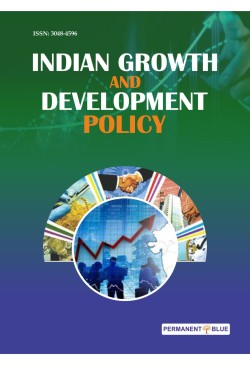
IGDPIndian Growth and Development Policy
Peer Reviewed Journal
Peer Reviewed Journal
India’s Trade Orientation with China: An Analysis of Intra Industry Trade
The present study examines the growth, share and Intra Industry Trade (IIT) of India-China during the period 1996-97 to 2019-2020 using two-digit level HS code data. The Grubel-Lloyd (GL) index is used to measure aggregate and weighted IIT between two countries. The findings reveal a gradual increase in IIT over the study period; however it remained below 30 percent and was accompanied by a persistent trade deficit. During 2019-2020, twenty-three products recorded with more than 50 percent IIT including nine agricultural and fourteen manufactured products. The analysis indicates the presence of India–China export oriented IIT in agriculture and allied products and manufactured products recorded in top five HS codes with more than 90 per cent GLi values in the year 2019-2020. The study highlights opportunities for expanding bilateral trade, particularly in agriculture and manufactured products and suggests promoting mineral products exports to China, which exhibit export-oriented IIT patterns.
Keywords: Grubel Lloyd Index, HS codes, Growth Rates, Trade Balance.
JEL Codes: F10, F14, N70.
Ramanjeet Kaur & Meena (2026). India’s Trade Orientation with China: An Analysis of Intra Industry Trade. Indian Growth and Development Policy, 2: 1-2, pp. 1-23.
Female Labor Force Participation and Government Digitalization
The global female labor force participation rate decreased over the last two decades. Moreover, women are increasingly falling behind men in digital skills and literacy while the world is experiencing rapid technological transformation driven by digital technologies. The purpose of this study is to explore whether a country’s online participation induces female labor force participation. Using cross-section data for 113 United Nations member countries for the year 2022, this paper investigates how a country’s use of government implemented digital platforms influences female labor force participation. The results reveal that the impact of the utilization of digital platforms on female labor force participation is positive and statistically significant. Additionally, this study finds that the effect of e-participation on female labor force participation is stronger for relatively low-income countries.
Keywords: Labor force participation, gender divide, e-government, e-participation, prosperity
JEL Classifications: J2, L86, H11
Atrayee Ghosh Roy (2026). Female Labor Force Participation and Government Digitalization. Indian Growth and Development Policy, 2: 1-2, pp. 25-36.
Inevitable Economic Disparity in India – A State-wise Analysis
The economic growth of India is neither uniform nor equitable across the state/regions, few states are having moderate level of socio-economic development, while most of the states are lagging behind for decades. The availability of economic resource (income and wealth) between rich and poor is gradually increasing and creating a huge gap (social divide) among the citizens in the country. The paper presents a detailed compilation of some socio-economic parameters including human population, GSDP, per capita NSDP, poverty ratio etc. across the states. Some quantitative techniques have been applied to map distribution across the country and presented using GIS tools. The information presented in the paper is a dispersal outline of above parameters in readily available module, which could be used as a reference by the stakeholders and administrator/planners for their valued judgement and assessment. Availability/accessibility of time-series data on various parameters is a limiting factor and hence the temporal dimension has not been considered. A detailed theoretical cross-section, temporal study would help to explain the causal relationship between economic growth and social inequality. Hence, the work leaves space for further research through the deployment of a host of techniques/methods in the domain of the welfare economics.
S.N. Nandy (2026). Inevitable Economic Disparity in India – A State-wise Analysis. Indian Growth and Development Policy, 2: 1-2, pp. 37-50.
Migration, Trafficking in Tribal Women and Crime in Eastern India
Almost 8.6 per cent of the total population of India, known as Scheduled Tribes, are in the grip of numerous catastrophes owing to the prevalence of a vicious circle of poverty and unemployment with rapidly deteriorating common property resources. As a coping mechanism to find temporary respite from such a critical situation, the vulnerable tribes resort to migrating to other states in search of employment and livelihood. In this process of migration, the tribes in general and tribal girls and women in particular are susceptible to trafficking, leading to harassment, denial of social justice and are frequently exploited physically, morally, economically and sexually. They have been victims of countless crimes, both because of their innocence and lack of hearing of their grievances, which have been exemplified through the plethora of reports illustrating the plights of tribal women and their sexual exploitation in various newspapers.
The present paper, with the help of mostly secondary sources of data, examines the nature and incidence of trafficking and the consequent crimes inflicted on the migrant tribal women of two tribal-dominated states, Jharkhand and Odisha in eastern India; summarises the socio-legal aspects of migrant tribal women labourers and portrays the policy implications of the study.
Keywords: Tribal Women Trafficking, Migration and Livelihood, Labour Exploitation Jharkhand and Odisha.
S. N. Tripathy (2026). Migration, Trafficking in Tribal Women and Crime in Eastern India. Indian Growth and Development Policy, 2: 1-2, pp. 51-89.
Structural Transformation of The Indian Economy: From Agriculture to Services
This paper examines the structural transformation of the Indian economy from an agrarian-dominant system to a services-led growth model over the period 1950–2024. Unlike the classical trajectory observed in Western industrializing nations—where manufacturing served as the intermediary between agriculture and services—India has experienced a distinctive leap, bypassing a sustained manufacturing phase. Using time-series data from the National Statistical Office (NSO), Reserve Bank of India (RBI), and World Bank Development Indicators, this study employs trend decomposition, shift-share analysis, and ordinary least squares (OLS) regression to quantify the pace, direction, and determinants of India’s structural change. The findings reveal that the services sector’s share of Gross Value Added (GVA) rose from 30.5% in 1950–51 to 54.6% in 2023–24, while agriculture declined from 51.9% to 15.0% during the same period. However, employment reallocation has significantly lagged output reallocation, creating a structural dualism characterized by low-productivity employment retention in agriculture. The paper further identifies liberalization (1991), information technology expansion, urbanization, and human capital accumulation as primary drivers of this transformation, while flagging premature deindustrialization and agrarian distress as policy concerns. The study contributes to the literature by offering an integrated quantitative assessment of India’s anomalous structural path and its implications for inclusive growth.
Keywords: Structural transformation, Indian economy, services-led growth, premature deindustrialization, sectoral productivity, Gross Value Added.
JEL Classification: O14, O53, L80, Q10.
Gulab Singh (2026). Structural Transformation of The Indian Economy: From Agriculture to Services. Indian Growth and Development Policy, 2: 1-2, pp. 91-119.
Undernutrition Among Tribal Children of Odisha: A Meta-analysis
Tribal children in Odisha face a significant problem of malnutrition and have been lower than the national/state average over the last 5 to 10 years. The study aims to collect community-based evidence to estimate the overall prevalence of stunting, wasting and underweight among tribal children in Odisha between 2015 and 2025. A systematic literature search identified studies reporting anthropometric indicators among tribal children in Odisha. Screening was performed using Rayyan software, study quality assessed through AXIS checklist, and meta-analysis was conducted in JAMOVI. The I2 statistic was used to evaluate heterogeneity and funnel plots; the Egger regression test was employed to assess publication. Based on nine studies involving 2,868 tribal children, this meta-analysis showed that the prevalence of stunting was 46.7% (95% CI: 34.6–58.8), wasting was 38.9% (95% CI: 19.9–57.9), and underweight was 56.9% (95% CI: 4.9–68.9).There was considerable heterogeneity across studies, mainly due to differences in tribal groups, ecological settings, and access to public health services. Egger’s test revealed no evidence of publication bias. The findings revealed the disproportionate burden of undernutrition on tribal children in Odisha. This highlights the need for tribe specific health interventions. These findings support the development of specific tribal nutrition strategies and longitudinal studies across all tribal children, including PVTGs that include anthropometric, dietary, and sociocultural factors, which are essential for understanding the causes and policy guidance over time.
Keywords: Tribal children, undernutrition, stunting, wasting, underweight, Odisha.
Bimalendu Patel, Basanta Kumar Bindhani, Saubhagya Laxmi Singh, Snehalata Sahu & Rashmita Jena (2026). Undernutrition Among Tribal Children of Odisha: A Meta-analysis. Indian Growth and Development Policy, 2: 1-2, pp. 121-136.